The following memoir was originally addressed to Prof. Allan R. Millett of Ohio State University in response to an article about Captain James Hausman. I have made every attempt to remain true to the original manuscript, down to the punctuation and strike-outs, however some annotations were unclear and are noted in [brackets]. Photographs are from Dad's archives and, hopefully, reflect the text where they are included.
Lenox, MA, 4 May 1996
I have read and re-read your account of the career of Capt. Jim Hausman in Korea and of his crucial part in the establishment of the Korean army. I am proud to have been associated with him in the early days of the Korean Constabulary, and I heartily endorse all the complimentary things which you and by quote others have said about him in your article.
I think that most of what I can contribute to your study will be anecdotal, but some of it may be of value. I kept no documentary records as such. Indeed my own personal military 201 file was inadvertently destroyed during a housecleaning following a cross-town residential move in Pittsfield, Mass, including the original of a letter of commendation from Mr. Riu Tong Yul, Director of the Korean Department of Internal Security, for my services with the 6th Korean Constabulary regiment in the Taegu uprising of October 1946. Other documentation I have none. I do recall having written a letter to Constabulary headquarters at that time in which I referred to: "this powder keg on top of which we are all sitting."
I don’t know what attention ever was paid to that; but in the light of what I have read in your account, you have told me much more about what was going on in Korea in those days than I ever knew at the time.
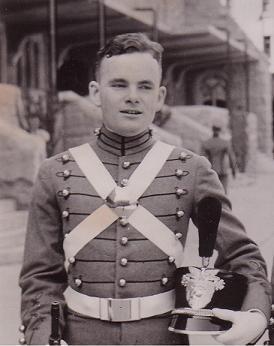 However,
to begin at the beginning, I graduated from the Military Academy in June of
1943. In June of 1944, as an artillery observer with the 230 Field Artillery
(30th Div) in Normandy I was able to destroy a German strong point
at a crossing of the small river, Elle, at Ste Margurite d’Elle, thus enabling
the 116 Infantry (29th Div) to advance practically unopposed. The
commanding officer of the 116th, Col. Carnham, was elated (they
could have lost a lot of men if he had tried to force that crossing by
infantry assault.) and with a bandage on one hand and his pistol in the other
danced almost like a schoolboy. Later, after dark, I was wounded in a pistol
encounter with two of the retreating Germans. After four months in hospital in
Shrophire, I rejoined the 230th and ended up the war in Europe on
the river Elbe at Aken near Magdeburg, in Germany. [He doesn't
mention that he received the Bronze Star and Purple Heart for these actions.]
However,
to begin at the beginning, I graduated from the Military Academy in June of
1943. In June of 1944, as an artillery observer with the 230 Field Artillery
(30th Div) in Normandy I was able to destroy a German strong point
at a crossing of the small river, Elle, at Ste Margurite d’Elle, thus enabling
the 116 Infantry (29th Div) to advance practically unopposed. The
commanding officer of the 116th, Col. Carnham, was elated (they
could have lost a lot of men if he had tried to force that crossing by
infantry assault.) and with a bandage on one hand and his pistol in the other
danced almost like a schoolboy. Later, after dark, I was wounded in a pistol
encounter with two of the retreating Germans. After four months in hospital in
Shrophire, I rejoined the 230th and ended up the war in Europe on
the river Elbe at Aken near Magdeburg, in Germany. [He doesn't
mention that he received the Bronze Star and Purple Heart for these actions.]
At the war’s end we began occupation duty in place – in our last tactical positions. Our battalion (the 230th) was assigned a position of the state of Saxony; and each of us battery officers was detailed to the governance of some country towns within our battery’s district. My own jurisdiction was the villages of Gransdarf, Zuchau, and Dornbock, plus a large manorial estate called, if I remember correctly, Sachsendorf.
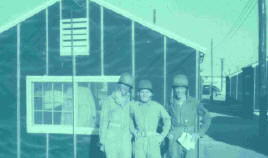 Our
duties primarily were two-fold: First, to remove members of the NAZI party
from local governmental offices and replace them with recommended non-NAZIs,
cleared by the CIC; and second, to begin arranging the return of DPs
(displaced persons, a euphemism for slave labor) to their various countries.
Our area had predominantly Russians and Poles. The problem of the Russians was
fairly simple, because most of them simply wanted to go home. But not all.
When we sent trucks to pick up the people from my villages, the number of
vehicles was planned for a certain seating capacity with an allowance for
personal effects, etc. Instead, when I went to dispatch the trucks, I found
them loaded to capacity with bags of grain, potatoes, and other produce so
that there was nowhere for the passengers to sit but on top of all this cargo.
Consequently, the folks at Sachsendorf had to be left behind. The spokesman
for our Russian contingent, Lt. Sergei Bitjukoff, a very fine young artillery
officer, captured at Stalingrad at the age of nineteen, was anxious that I
should bring them to the transfer point in Magdeburg also. I promised to do my
best, but it didn’t work. The folks at Sachsendorf had agreed among themselves
and simply refused to go.
Our
duties primarily were two-fold: First, to remove members of the NAZI party
from local governmental offices and replace them with recommended non-NAZIs,
cleared by the CIC; and second, to begin arranging the return of DPs
(displaced persons, a euphemism for slave labor) to their various countries.
Our area had predominantly Russians and Poles. The problem of the Russians was
fairly simple, because most of them simply wanted to go home. But not all.
When we sent trucks to pick up the people from my villages, the number of
vehicles was planned for a certain seating capacity with an allowance for
personal effects, etc. Instead, when I went to dispatch the trucks, I found
them loaded to capacity with bags of grain, potatoes, and other produce so
that there was nowhere for the passengers to sit but on top of all this cargo.
Consequently, the folks at Sachsendorf had to be left behind. The spokesman
for our Russian contingent, Lt. Sergei Bitjukoff, a very fine young artillery
officer, captured at Stalingrad at the age of nineteen, was anxious that I
should bring them to the transfer point in Magdeburg also. I promised to do my
best, but it didn’t work. The folks at Sachsendorf had agreed among themselves
and simply refused to go.
It was there I realized that what was later become known as the "Cold War" had already begun. With the war scarcely over, the Russians had already begun widening the railroad tracks from the standard European and American gauge to the Russian gauge – four inches wider – thus cutting off the Russian zone from the rest of Europe.
We were then transferred to Thuringia and turned over our part of Saxony to the British 52nd Division. The unit which replaced us was a battalion of the Cameron Highlanders. Our duties in Thuringia consisted mainly of patrolling and investigation. In the course of my nosing around, I came across a boxcar load of guidance systems for the V-1 buzz bombs. I picked up two of them (all my jeep could carry in their shock-suspended packing cases). I turned one in to US intelligence and gave the other to a party of British naval ordnance officers who were temporarily attached to our battalion headquarters in the town of Saalfeld while they themselves were investigating a German torpedo factory located nearby.
Then we headed for home – but by way of England where we conducted further training because we were slated for the invasion of Japan. That, fortunately, didn’t happen, and after a trip home on the Queen Mary, her first "peace-time" voyage after the war. The 30th Division was demobilized at Ft. Jackson, SC.
After brief tours with the 20th and 2d Armored divisions, I was ordered to the Military Government School at Carlisle Barracks, PA. I think I may have been two or three classes behind Jim Hausman there.
So far, all this may have sounded extraneous to you. I have told it mainly to show where I came from.
I arrived in Inchon in August of 1946 and learned that I was to be assigned to the Military Government of South Korea and under that to an outfit called the Korean constabulary. This was good news. I had known about the Philippine Constabulary from my grandfather’s long service in the Philippines; and this promised to be more of the same. Fine. After a very skimpy orientation, I took the train for Taegu, Kyonsonang Pukto, and assumed command of the 6th Regiment, Korean Constabulary.
This was at the stage of development where, according to your description of Co. Barros’ plan, each regiment would begin with a nuclear company of 225 men and constitute the basis for further recruitment and training. The Senior Korean officer (my advisor until, under Col. Barros’ plan we traded places, and he became commanding officer and I his advisor) was Capt. Kim Jong Sirk. Capt. Kim was a quiet, diligent officer, a veteran of the Japanese army and one of the few Koreans to command Japanese troops in combat. Apparently his combat didn’t last long. His company was assigned to a defensive position in Okinawa with his platoons deployed in a line and his command post in a cave dug in a hillside. He said that from the time the American artillery preparation hit he never saw his platoons again. After gasoline was poured down a ventilating shaft and ignited, he and his CP group came out of their cave with their hands up into the waiting arms (and bayonets) of the American infantry.
My arrival in Taegu was very soon greeted by an epidemic of cholera. The Sixth regiment was called upon to establish checkpoints to restrict movement in and out of the afflicted area. Some of my men caught the disease. In visiting them in the Taegu hospital I got a look at what life in an oriental hospital must be like. The hospital did what it could in the way of medical care for the patients, but food, blankets, etc. were the responsibility of the patients’ families. Consequently, there were family members camping out on the benches and the floor in the hallways looking after their patients. For soldiers of the Sixth Regiment, this service was provided by the medical detachment of the regiment. A desk had been established in one of the corridors of the hospital from whence meals were dispatched to Constabulary patients and where the men’s families could inquire about the whereabouts and welfare of their relatives. This was the work of Capt. Kim Jong Sirk and our medical officer; another Capt. Kim, but whose given name I do not remember. It suffices to say that all of our men recovered, and we did not lose any to the epidemic.
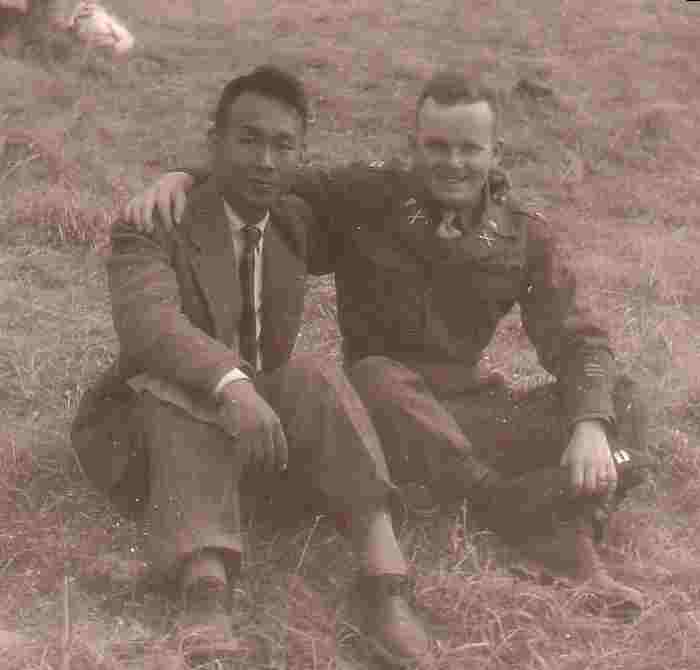 At
this point I should say that my relations with the provincial military
government of Kyongsang Pukto and with the United States 1st
Infantry in Taegu were much closer than they were with the Constabulary
headquarters in Seoul. Tactically I took my direction from the 1st
Infantry; and logistically and financially I got most of my support from the
provincial Military Government. I belonged to their club, took most of my
meals in their mess, and much of my social life at the time was involved with
them;
At
this point I should say that my relations with the provincial military
government of Kyongsang Pukto and with the United States 1st
Infantry in Taegu were much closer than they were with the Constabulary
headquarters in Seoul. Tactically I took my direction from the 1st
Infantry; and logistically and financially I got most of my support from the
provincial Military Government. I belonged to their club, took most of my
meals in their mess, and much of my social life at the time was involved with
them; although I did for a time (as one of the few young bachelor
officers) date Col. Evers’ (CO, 1st Inf) daughter.
No sooner had the cholera epidemic subsided than the October 1946 riots in Taegu broke out. These, I was told, were a serious attempt to overthrow the government’ but they never got that far. Again in the absence of any direction from Seoul, the Sixth Regiment took its direction from the 1st Infantry. We assumed responsibility for guarding traffic in and out of the city of Taegu and for protection of sensitive points such as rail bridges and tunnels, and telephone and electric terminals throughout Kyongsang Pukto. I worked mainly with the regimental executive, Lt. Col. Max Roth in these matters.
During the October riots the 6th Regiment was mainly called on for guard duty, but we did do a certain amount of patrolling, not only locally to connect our guard posts, but also to outlying parts of the province. The only shooting I recall was on a patrol which I happened to be accompanying. This was at a village near the town of Kurnchon in northwestern Kyongsang Pukto. When we stopped to check out the village, some of the young men began running for a wooded hill a short distance away. Some of the patrol opened fire on them but were soon reined in by their officers. We had no reason to go after those fellows, anyway. The rest of the village seemed to be quite in order; and so we went our way.
By this time Capt. Kim Jong Sirk had been transferred – I don’t know why or to where – and replaced by Maj. Shim Un Bong. Recruiting was going on apace. The first battalion grew to full strength, and development of the second battalion had begun.
Recruits came willingly. Employment in the country had not picked up much; but with the Japanese recently expelled, nationalist feeling was on the rise. I remember one young fellow who came into our headquarters bring his own crudely made banner emblazoned with "MY COUNTRY" written in his own blood.
We had outgrown the premises of the Taegu motor transport school and for the second battalion had obtained the use of the former fish net factory in Taegu.
We had formed a regimental band, which I maintain was the finest in the Constabulary. In addition to standard march music, which they already knew, I had taught them US Army occasional music (e.g. the Dead March, which they used when one of our men was accidentally killed, the Rogue’s March, which happily we had no occasion for while I was there). I also taught them the General’s March and the ruffles and flourishes, which they rendered to perfection when Gen. Dean (Military Governor of Korea) came to Taegu. The general took it in stride, but his chief of staff, Col. Champeney, was highly impressed and came out of his way to tell me so. (Later, after I had taken over as advisor to the 1st Brigade, the American lieutenant advisor to the 8th Regiment boasted to me what a find band he had, but when Gen. Dean came to visit there – in Wonju – their band turned in a rather sorry performance. Col. Champeney was not at all pleased and again came out of his way to tell me so and to do something about it.)
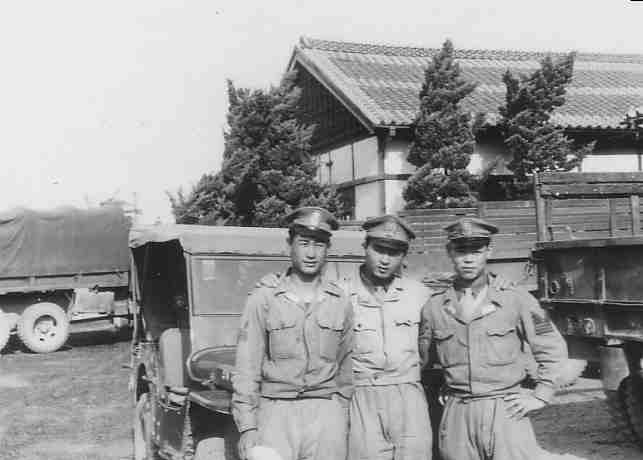 All
the while we conducted a fairly comprehensive training program based mainly on
the experience of the Japanese-trained officers in the unit. All the platoon
leaders, indeed all the lieutenants had been trained in the Korean student
army in Japan. Of these, Chang Do Young was outstanding. I believe he was from
Yongampo, at the mouth of the Yalu river. Handsome, personable, energetic,
resourceful – he was a natural leader, and a good one. I’m afraid I sang his
praises too much to Jim Hausman, because I soon lost him. I didn’t see him
when I went back to Korea in the early spring of 1953. I was there as ADC to
Lt. Gen. John W. O’Daniel, Commanding General of the US Army, Pacific. We went
to visit Paik Sun Yup headquarters in Taegu. Gen. Paik recognized me
immediately and announced me to his staff.
All
the while we conducted a fairly comprehensive training program based mainly on
the experience of the Japanese-trained officers in the unit. All the platoon
leaders, indeed all the lieutenants had been trained in the Korean student
army in Japan. Of these, Chang Do Young was outstanding. I believe he was from
Yongampo, at the mouth of the Yalu river. Handsome, personable, energetic,
resourceful – he was a natural leader, and a good one. I’m afraid I sang his
praises too much to Jim Hausman, because I soon lost him. I didn’t see him
when I went back to Korea in the early spring of 1953. I was there as ADC to
Lt. Gen. John W. O’Daniel, Commanding General of the US Army, Pacific. We went
to visit Paik Sun Yup headquarters in Taegu. Gen. Paik recognized me
immediately and announced me to his staff.
(You probably know more about this than I do.) I believe I read in the papers at the time of Park Chung Hi’s overthrow of President Syngman Rhee, Chang Do Young was chief of staff and that because he did not immediately double-cross President Rhee and Join Park’s insurrection, Park accused him of treason and had him sentenced to be shot. I never heard that such a sentence was carried out. My Korean tailor friend in Pittsfield, MA, knew of Chang and said that he believes he is alive and living in the US.
For the year or so that followed the Taegu uprising the 6th Regt continued recruiting and training. We established the third battalion of Pohang, Kyongsang Pukto, at the former Japanese air base when it was vacated by the battalion of the 1st US Infantry which had been stationed there. (I don’t know why the US Air Force never used that base. If it had, the Pueblo incident need never have happened.)
Maj. Shim Um Bong, a quiet, mild-mannered officer of reasonable capability was succeeded in command by Lt. Col. Choi Nam Kun; I don’t know what Col. Choi’s military background was. He was older than the Student Army officers. He was a North Korean, who had only recently come across the border – so recently that his family was still in the North. We got them a house in the Military Government housing compound in Taegu. Some of our other senior officers lived there too, including Maj. Paik In Yup (brother of Paik Sun Yup); and the 6th Regiment maintained a guard detail there. I told our finance officer, Lt. Che Kiang Nam, that he could sneak enough money out of our firewood account to pay the necessary bribes to get Choi’s family across the border.
I don’ t know what Hausman knew about Choi other than what I have written above, but that’s all he ever told me. It seemed odd to me at the time that this man could sneak into the country and receive a fairly senior commission seemingly with no questions asked. However he came with Hausman’s endorsement’ and I let it go at that.
As a commander Col. Choi didn’t seem to have much impact right off. But by then the regiment was widely enough distributed and well enough in hand under its battalion commanders; and so strong a hand at the center was not seriously missed – or so I thought. Still, he seemed a rather shifty type. I didn’t know whether this meant that he was unsure of himself in his new command or whether he had other things on his mind.
The 6th Regiment officers used to dine out together as a group occasionally. At one of these dinners Col. Choi intimated that he had fixed me up with the kesang girl who was serving me at the table. Fortunately I was able to tell him quite truthfully that I had to catch the train to Seoul immediately after dinner and couldn’t possibly stay. In any case I didn’t want to be beholden to him for such or any other favors. (I’m sorry of the kesang girl was disappointed.)
I was not sorry when Col. Choi was soon transferred to command of the 8th Regiment in Wonju Kangwon Do, but when later on I took over as advisor to the 1st Brigade, I had him to deal with all over again.
Col. Choi was succeeded in command of the 6th Regt by Lt. Col. Kim (I think his name was Pak Il, but I’m not certain). He was a youthful, pleasant, and effective commander’ and I was pleased with him. He also was from the Student Army.
About that time someone had given me a British army dictionary of English-Japanese and Japanese-English military terms. It was explicit and well illustrated, even though from the era of Lewis guns and short Lee-Enfields. This was a great find’ and I immediately set up a project of translating the US Infantry drill Regulations (FM 7-15, or was it 7-12, I forget) into the Korean language with a team consisting of a young, well-trained Korean corporal in our headquarters who spoke all three languages well, my Korean civilian interpreter, Lee Yong Koo, Col. Kim, and myself. [ms includes note here: "add British to Americ on translation"] It was an interesting and enjoyable project and was going quite well until Jim Hausman came to town and saw what we were doing. He immediately snatched my corporal and my dictionary away and transferred them to his own headquarters in Seoul. I’m sure it was appropriate that such an effort should be a product of the national headquarters rather than that of a field operation such as my own, but I still couldn’t quite forgive Jim for spoiling my fun. I don’t know what became of the project after that; but I never saw any output from it.
Also about the same time, we were joined by Maj. Choi Duk Shin, as regimental executive. He was the only officer in the command who spoke no Japanese. He had brown up in China and was a graduate of the Chinese military academy at Whampoa. He was fluent in German and had served as interpreter for the German colonel who was professor of military intelligence at Whampoa. He was an intelligent, conscientious officer who did a good job as regimental executive. I saw little of him after I went to the First Brigade. He did come to visit me in 1950 in Philadelphia when I was stationed there as an instructor with the Pennsylvania National Guard. We had dinner together. There were two other Korean officers with him whom I did not know. I had heard of the execution of Col. Choi Nam Kun following his treachery in the action in Cholla Namdo. One of the officers with Choi Duk Shin said that he had witnessed the execution. After what I had done to help Choi Nam Kun get established in the Constabulary, I felt a particular sense of betrayal over his behavior and was not sorry to see him go. The last time I saw Choi Duk Shin was in 1953 at an embassy reception in Tokyo where as a major general he was military attaché to the Korean embassy. Odd for a Korean who spoke no Japanese (but perhaps not so strange, because having grown up outside of Japan, he would be free of preconceived notions about the Japanese.); but his English had improved greatly. He was a very intelligent man, and may have learned Japanese as well.
As to the politics of the 6th Regiment, I hadn’t thought much about it when I arrived in Taegu, and nothing had been said about it when I was at the Constabulary headquarters for orientation and assignment. Nor was it much of an issue during my first month in Taegu, because the cholera epidemic was taking everyone’s attention.
Later, however, when the riots hit Taegu and vicinity, the question did arise. As you know, the National Police were thoroughly disliked because of their brutal Japanese ways. The Constabulary on the other hand, being uniquely Korean were quite popular at this point. However, they shared the popular dislike of the National Police. Consequently, when we were asked to provide guards around the city of Taegu and some sensitive locations, the officers were very dubious at first, because they did not want to be seen as supporting the police. It took some persuasion on my part to convince them that the uprising was not just against the police but against the entire government and that the safety of the nation was at stake. Moreover I reminded them that they were officers, they had their duty, and they would obey. After very little discussion they agreed; and the operation was on. The man, to my great satisfaction, responded not only willingly but enthusiastically, singing as they went. How much of this was patriotic fervor and how much was adventure and a welcome change from hum-drum training and garrison duty, I don’t know; but the whole thing worked out well. Our men performed reliably. Taegu was stabilized. Col. Evers and Col. Roth (1st Infantry) were pleased. Col. Adair (MG Kyongsang Pukto) was pleased. I didn’t detect any chicanery at our checkpoints (not that I in my naiveté would have known it if I had seen it’ but no such complaints ever reached me); and so I was pleased.
By this time we were beginning to look for subversion in our own ranks. A prime suspect was the senior sergeant in our medical detachment (I forget his name). We never had anything conclusive on him. My one observation of his performance of duty was when he was preparing for burial one of our men who was killed accidentally. (This was one of our guard detail on the Taegu Military Government housing compound. The soldier had let a small Korean boy pick up his rifle; and the kid pulled the trigger and shot him through the abdomen.) as I recall, that same soldier had told me earlier that he had been a sergeant pilot in the Japanese Air Force assigned to a fighter squadron in defense of Tokyo against the fire bombing raids, which did far more damage to Japan than Hiroshima and Nagasaki ever did. Their orders were to go find the American bombers and ram them kamikaze-style. The Japanese radar, if any, was inadequate; and ground-control intercept; GCI, non-existent. The B-29s came over at thirty thousand feet. The fighters would mill around at ten thousand feet and then come back and say "we couldn’t find them."
However that may have been, all I ever had on that medical sergeant was suspicion. After I had moved to the First Brigade, I did hear that he had deserted and was suspected of engaging in subversive activities; but where, I knew not.
We didn’t get much help from the American CIC. I met from time to time with the captain in charge of the Taegu detachment. (I have completely forgotten his name.) He filled me with tales of a "brother-in-blood" custom among Korean subversives wherein a needle and thread would be pierced in and out of the skin on the wrist of one participant then through the wrist of the other and back around until the blood of the two had been mixed together. As a result of this I was supposed to be able to identify such persons by telltale black dots on their wrists. And furthermore, I was supposed to find similar identifying black dots about the anal region.
Very shortly afterward, that captain suddenly disappeared and I could not learn whither or why. But, much later on (during Lt. Col. Kim Pak Il’s command, and not long before I left Taegu for Susaik) I found that my men were holding two prisoners. It was one evening in my office in the headquarters I had them brought before me and Col. Kim. It seemed that they were young newspaper reporters who had printed something my people didn’t like. Upon examination they showed some small round burns upon their legs. Someone explained that "oh yes, the guards were just stubbing out their cigarettes". When I examined their wrists for CIC Captain what’s-his-name’s tell-tale black dots, there weren’t any. That was enough. I decided to spare myself and the prisoners the embarrassment of any more detailed examination of their anatomy and told the officers to let them go. My civilian interpreter, Lee Yong Koo, said: "But sir, they have dishonored our Constabulary." I said that so they may have, but they haven’t hurt us. In a free country they may say what they want so long as it is not causing undue alarm or disorder. In any case, we have no lawful power of arrest. If we have a legal complaint against them it is a matter for the police. We are not the police, and we should not be seen as acting like the police. "Let them go."
As far as I ever knew, Col. Kim did release the two, for I never heard any more about them. As for the CIC captain, his notions about exotic rituals and his interest in remote parts of the anatomy suggested a possible reason for his sudden removal. I never knew.
The next senior member of the CIC detachment in Taegu was a Korean-American Sergeant Kim. There was a camaraderie among houseboys in the Taegu area’ and some of them used to come and visit with my houseboys. Two of them worked for the CIC; and they told me about watching through a crack in the wall this same Sgt. Kim disporting himself with a local Korean belle.
Later on, in 1953, when Gen. Paik San Yup same to Honolulu, this same Sgt. Kim led the Korean community in a welcome for him.
My own part in Paik Sun Yup’s visit to Honolulu was to escort him on a launch tour of Pearl Harbor. In the course of the tour, Gen. Paik spotted a cruiser, the USS Minneapolis, as I recall, which had rendered valuable fire support to his corps during the war, and asked if he could visit the shop. We approached the accommodation ladder and answered the customary hail: "Boat Ahoy" with: "Korean Army". The officer of the deck was a bit flustered by the unexpected appearance of a four-star flag coming alongside. However, he did muster the requisite sideboys, piped the general aboard in proper style, and offered to summon the captain. Gen. Paik told him not to disturb the captain but only to inform him of his visit and to convey to him his appreciation for the support the ship had rendered his corps during the war. This was late in 1953.
Before I left Taegu, the 6th Regiment had raised its second battalion, quartered in the former Taegu fish net factory, and was in the process of establishing its third battalion at the Pohong airfield.
For the initiation of the second battalion Brig. Gen. Song Ho came to town. The 6th Regiment made him welcome in grand style. Our band and honor guard welcomed him at the railroad station as they had for Gen. Dean. I had borrowed a Buick sedan from one of the Taegu Military Government officers (his own brought from the States); and the general was driven through the streets of Taegu by my own driver, whom I was sure I could trust followed in a jeep) with a dismounted escort which double-timed alongside his vehicle. He seemed to be suitably impressed. His address to the new battalion, drawn up in a large lofting space in the fish net factory, was all bombast and fustian. He took most of an hour with the men standing stiffly at parade-rest. My Korean was not much, but I could recognize: "Song Ho this and Song Ho that," and finally, striking himself on the breast: "Nanun Song Ho inni-da!" (I am Song Ho!) all very dramatic, but the troops didn’t seem much impressed. An American sergeant standing with me at the time (I think from the 1st Infantry) thought Song Ho reminded him of an old Indian. And, as I thought back upon the occasion later at Ft. Sill, Song Ho did remind me of Geronimo. He gave me a 24-karat gold ring, which one of my daughters still has. Song Ho didn’t impress me as much of a commander; and when – if I heard it correctly – he later defected to North Korea, I didn’t count it as much of a loss.
My assignment to the 1st Brigade involved my moving my own operation to the headquarters at Susaik-nis, just north of Seoul. Until I could set up quarters at Susaik I had to stay in a transient hostelry in a school building in Seoul. Likewise, I had no organic transportation (which came later) but had to rely on vehicle drawn by the day from a central Military Government motor pool in Seoul.
It was during this transitional period that the March 19 holiday came up. This was the anniversary of a 1919 "Black Hand" uprising against the Japanese and a possible occasion for civil disturbances. The previous year, in Taegu, the command had gone on a sort of precautionary alert where American military personnel went armed, and the 6th KC Regiment tended strictly to its guard posts and accounted closely for its off-duty personnel.
But this year, up until the day I waited in vain for some kind of instructions from Constabulary headquarters, there having been none, I went to the D.I.S. headquarters in Seoul to see whether there was an alert or not. Col. Price was in rare form. Upon sight of me he exploded. "What are you doing here? Why aren’t you up on that line?" "Line--?" "Yes, the 38th parallel." (Was I to defend it with my .45? The emergency – if any – would be in the city, not on the frontier.) So, nothing would do but that I had to take one of the MGs citified jeeps (i.e. no entrenching tools and no emergency gas can and a one-day limit on use of the vehicle – I kept it for five days) and go and check my outposts.
All the outposts were snowed in’ and it was hard for my driver and me to
dig the jeep out of the snowdrifts with just
 our
gloved hands. At one point we were hopelessly bogged down, but fortunately a
party of wood cutters came by and were happy to dig us out in return for one
of the bottles of Burgundy which I always carried when traveling for my stops
at outlying French missions. (Although not a Catholic, I had developed a
circle of acquaintances among French missionaries at churches conveniently
located for lunchtime stops. I made a practice of carrying some wine and some
cheese. The Frenchmen made their own sourdough bread; and the combination made
a delicious lunch. The priests enjoyed the wine and seemed glad to welcome
someone who spoke their own language, however awkwardly.)
our
gloved hands. At one point we were hopelessly bogged down, but fortunately a
party of wood cutters came by and were happy to dig us out in return for one
of the bottles of Burgundy which I always carried when traveling for my stops
at outlying French missions. (Although not a Catholic, I had developed a
circle of acquaintances among French missionaries at churches conveniently
located for lunchtime stops. I made a practice of carrying some wine and some
cheese. The Frenchmen made their own sourdough bread; and the combination made
a delicious lunch. The priests enjoyed the wine and seemed glad to welcome
someone who spoke their own language, however awkwardly.)
Needless to say, the 38th parallel was quiet. However, my enforced tour of the border did afford me a chance to get acquainted with the men on the border posts; and that was all right.
The First Brigade headquarters at Susaik occupied what had been the headquarters of a Japanese engineer battalion. The brigadier was "Old Col. Lee" of the Old Col. Lee –Young Col. Lee father-in-law son-in-law combination of whom I think you know. (I don’t remember either of their full names.) I think Old Col. Lee had been a colonel of cavalry in the Japanese army. I quite liked him. He was a gentleman of the old school – we would have said: "the old Army". Genteel, dignified, and no nonsense. (When I left Korea I made him a present of my riding crop, which concealed a triangular bayonet and had a lead-weighted handle.)
I had two other American officers at the First Brigade. One was Capt. Robert W. Mawby [sp?] of the signal corps. He, of course, filled a very useful purpose as the brigade communications officer, which actually covered the whole of South Korea. The other was a lieutenant whose name I don’t remember and whose duties and reason for being there I never quite figured out. He was a Harvard type who seemed to think that Mao Tse Tung’s ongoing conquest of China was the greatest thing that could ever happen. I made him mess officer of our officers’ mess.
It was in the wisdom of someone in the Post Quartermaster of Seoul that we were required to establish a mess. We had requested a six cubic foot household refrigerator and a household kitchen stove but were told that these could only be issued to family quarters. Thus, as bachelor officers, we were required to accept a pair of gasoline field ranges and a sixty-five cubic foot mess hall refrigerator. One thing led to another. The refrigerator overloaded the pole transformer which supplied our quarters and the brigade radio station next door. When I obtained a larger transformer from the Post Engineer of Seoul, the new one put out so much power that a report reached us that a broadcasting station in Los Angeles had complained we were interfering with their signal. Our transmitters were old Japanese vacuum tube equipment with probably a lot of frequency scatter. Mawby procured more modern transistorized equipment of lower power but much greater efficiency, which settled that matter.
The story of the mess went on. Our Korean cooks were perfectly capable, but someone in the Quartermaster ordained that this would not do. We had to have an American mess sergeant. Accordingly, we were assigned a Spec-4 (a real rummy cast off from some local outfit) and a young cook’s helper. They didn’t interfere with our regular cooks (the chief of which had been a dining car chef on the South Manchuria Railroad), but they did make themselves useful by going to the commissary, where they apparently had come connections, to draw our rations (and where our sergeant could load up on ingredients for the moonshine distillery he was setting up.) We had to pad the head-count most shamelessly to make our mess look legal, but such was the name of the game.
This was some of the nitty-gritty of getting established in the 1st Brigade. There were more serious matters. To begin with were visits of inspection to the various regiments and establishing communications and operating procedures between them and the brigade.
On one such visit on the return trip from Wonju to Seoul I rode with Gen. Dean in his diesel rail car. We had a long chat about what the future might hold for Korea. My own thought was that with the Koreans’ talent for skilled work with their hands and with limited resources of raw materials, etc., such products as small machines, electronics, and the like ought to offer a likely prospect for development. Gen. Dean agreed, and we also thought that the country needed a dairy industry. He suggested that the brown Swiss cattle [*Highland cattle], with which he had some acquaintance, ought to do well there. Korea has come a long way since then.
When spring came I was asked to conduct a reconnaissance of a likely route of invasion from North Korea. In view of the mountainous terrain to the east, over which I had been in winter weather, it seemed to me that the most likely route of advance for such an invasion would be down the valley of the Imjin river directly towards Seoul. Accordingly, I set out with the brigade S-2 and S-3 to explore this route. We found that the river was constrained by high vertical banks cut through a clay alluvial flat and that the main valley was bordered by high hills on both sides. Our crossing of the Imjin river was by a manual scull-propelled ferry which could carry my jeep, a couple of commercial trucks and ox-carts, and numerous pedestrian passengers. It was plain that an invasion force would have to have its own river-crossing equipment. Climbing the hills bordering the valley didn’t reveal much. My Korean officers were amused when we approached a hilltop on the 38th parallel, and I pumped a round into the chamber of my .45. (They were unarmed; and that was as much for their protection as my own.)
My report to the D.I.S. reflected the above.
My final months in Korea were largely concerned with distribution of American weapons to the Korean units.
Earlier on, I had recommended to Col. Price that we establish a mounted cavalry branch, in view of the inadequacy and sometimes non-existence of the road net. However, Col. Price did not want to contradict himself, because when the National Police had made a similar request, he had testified against it because there was not enough fodder in the country to support such an operation.
Also, I had recommended establishment of an artillery branch, and as an artillery officer would have been willing to extend my tour in Korea to get it started. However, the equipment was not available. Hausman had authorized me to canvass all the ordnance depots in the country (three, I think) for artillery equipment; but I found none. I had hoped at least to find some of the sawed off 105mm howitzers with which the infantry cannon companies of WWII had been equipped; but no such luck. And I never did know what had become of the self-propelled 105s which the 1st Infantry had used to such good effect during the Taegu uprising in 1946. I forget the model number, but these were the so-called "Priest" type on the hull and machinery of a Mk3 tank but with the full-size 105mm howitzer on a forward-facing open carriage and a .50 caliber machine gun on a ring mounted on the starboard bow, suggesting a pulpit. Hence, I suppose, the name.
My last duty before leaving Korea was the distribution of American weapons to the Korean regiments. Here again Col. Price distinguished himself. He was apparently exercised that I could not personally account for every last weapon in these shipments. I had no English-speaking administrative personnel. I did know and had observed that issues to the various regiments had been broken down by the Korean ordnance according to need and loaded into boxcars with appropriate manifests provided. The best that I could do was to observe that the right carloads were delivered to each regiment and to obtain receipts for the manifests from the commanders or supply officers, which I did.
During this time I had to attend to a sticky situation regarding what was then known as "Korean Hollywood", a center for the production of motion pictures. This was at or near Uijonbu, which has since become notorious for other reasons. The place was protected by a guard detachment from the 1st KC Regiment. However, some of the Korean actresses were carrying on in some manner with American soldiers from nearby units on the 38th Parallel. As might have been expected, the Korean soldiers took a dim view of this and were mistreating the girls most harshly. (Those who think that racism is bad in the USA have never been to the Far East.) The Americans involved had commandeered a truck, rounded up their girls, broken through the Korean guard (who would not have fired upon them in any case), and carried the girls off to some refuge in Seoul.
[end of narrative]
Korean Constabulary:
Lt. Col. Russell D. Barros
Capt. Kim Jon Sirk
Maj. Shim Ung Bong
Lt. Col. Choi Nam Kun
Lt. Col. Kim (Pak Il-?)
Col. (later Gen.) Paik Sun Yup
Maj. Paik In Yup
Col Evers, CO 1st US Infantry
Lt. Col Max Roth Ex 1st US Infantry
Col, Alexander Adair, Mil. Governor of Kyongsang Pukto – was from Wyoming – was ROTC instructor at McKinley High School in Honolulu when Buster Crabbe, Olympic swimmer and "TARZAN: actor was a student there.
Lt. Chang Do Young (later chief of staff, Korean army)
Lt. Che Kiang Nam – finance officer, 6th Reg’t
Lt. Choi Yeung Hi – platoon leader; much later Lt. Gen.
Lt. Lee Sang Cheul – supply officer, 6th Regt, later Col, Piv C/S
Maj. Choi Duk Shin, later Lt. Col, then Maj. Gen
Old Col. Lee (Yi), Brigadier, 1st Grig, KC Susaik-nd Kyonggi-do
Young Col. Lee – his son-in-law; a very able officer
Mr. Eugene reichard, forestry, Kyongsang Pukto
Mr. John W. Peabody, TC, Kyongsang Pukto
Lt. John Bodley, 2d KC Regt
Capt Clarence de Reus, 4th KC Regt
Lt Bill Hitchcock, Public Relations, Province of Kyongsang Pukto
Lt Col Norman R. Anderson (wife Myrne), agriculture ministry, province of Kyongsang Pukto
Capt ( ) Kim – med off 6th KC
Capt Raymond LV Pearson – trans corps, port of Pusan
Lt John Day USCG-Korean Coast Guard Station, Pohang, Kyongsang Pukto
Capt Raymond U Mawby, Signal Corps advisor, 1st Brigade, Korean Constabulary
Col Yu Ik Hang (?) 1st Brigade, KC
Houseboy – Kim Hak Ung (Kimchi), honest and faithful
Sgt Hong Sung Po, my faithful driver
Mr Riu Tong Yul (Dir DIS)
Bishop Germaine Mousset, retired and emeritus Bishop, Diocese of Kyongsang Pukto
Fr. Louis Cadars – Assistant to Bishop Mousset
WO (Gunner) RN, Fred Villiers, HMS Alacrity (sloop of war)
Capt John R Kauffman, wife Betty, Provincial government, Kyongsang Pukto
Mata Axel Jensen (USATS) (shipwrecked on Cheju-do)
Soeur Agatha – Superior, sisters of St. Paul de Chargres, Taegu
Maj Gen William Dean, Military Governor of Korea
Col ( ? ) Champeney, his chief of staff (as I recall)
Col Terrell E Price – Senior Adviser, Korean department of Internal Security (DIS) – the Ward Department
Song Ho, Brig Gen, KC